
thinking with: Madeleine Collie
'thinking with:' is a series of conversations with critical thinkers, rooted in study as a collective practice that exceeds institutional forms even as it moves through them.

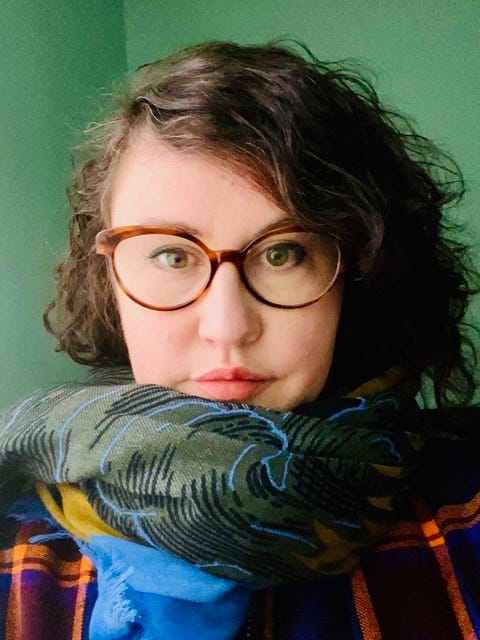
Madeleine Collie: Photo by James Collie
Food appears throughout Madeleine Collie’s work not simply as a subject of artistic inquiry, but as a method for thinking with questions of ecology, extraction, memory, and collective life. Madeleine is a writer, artist and curator. Her work explores ecosystems in flux, working with artists, activists and scientists to expand the way we experience ecological narratives.
As founder of the Food Art Research Network (FAR), she has spent the last several years convening artists, researchers, growers, curators, and cultural workers across geographies through what she describes as a “network of living relations.” Through the years School of Instituting Otherwise and Far Network have collaborated and most importantly been in conversation to think through this idea of networked communities.
In this conversation, we speak about food as pedagogy, kitchens as sites of study, collective research, friendship as infrastructure, and why practices of gathering might help us rehearse other futures.
thinking with: is a series of conversations rooted in study as a collective practice that exceeds institutional forms even as it moves through them. Engaging questions of collapse, abolition, solidarity, and survival, the series foregrounds thinking as something done together, in the midst of constraint and struggle. Conversation here is not a platform for positions, but a practice of holding open ways of instituting otherwise.
*All Images Courtesy: Food Art Research Network.
Meenakshi Thirukode (MT) : What drew you to working with food as a medium for research and collective practice? Was there a particular moment where food opened something up that other methods could not?
Madeleine Collie ( MC): I like this question because it asks me to think about food as a method rather than as a topic.
I’ve always been interested in how we learn more horizontally. I’m interested in what happens when we’re in a field planting things next to each other, learning shoulder-to-shoulder. There’s something about how the body moves with others and coordinates itself with others that creates a different kind of learning.
The first time I consciously worked with food in a curatorial practice was through a project in Folkestone. We walked through the Warren gathering wild herbs and then met local fishermen who were thinking through the politics of fishing during Brexit. What emerged through that walk was this greater awareness of the ways our metabolisms are internationally connected. Food opens up questions about migration, trade, ecology, labour, colonisation, and belonging all at once.
Food does this thing where it’s both somatic or embodied and political. It’s connected to markets, it’s a commodity, it’s part of our daily economy. But it also does something that we internalise and makes physical these realities. Our food becomes our body, essentially. It enfleshes complex political realities that we aren’t necessarily always confronting, but that we’re always embodying.
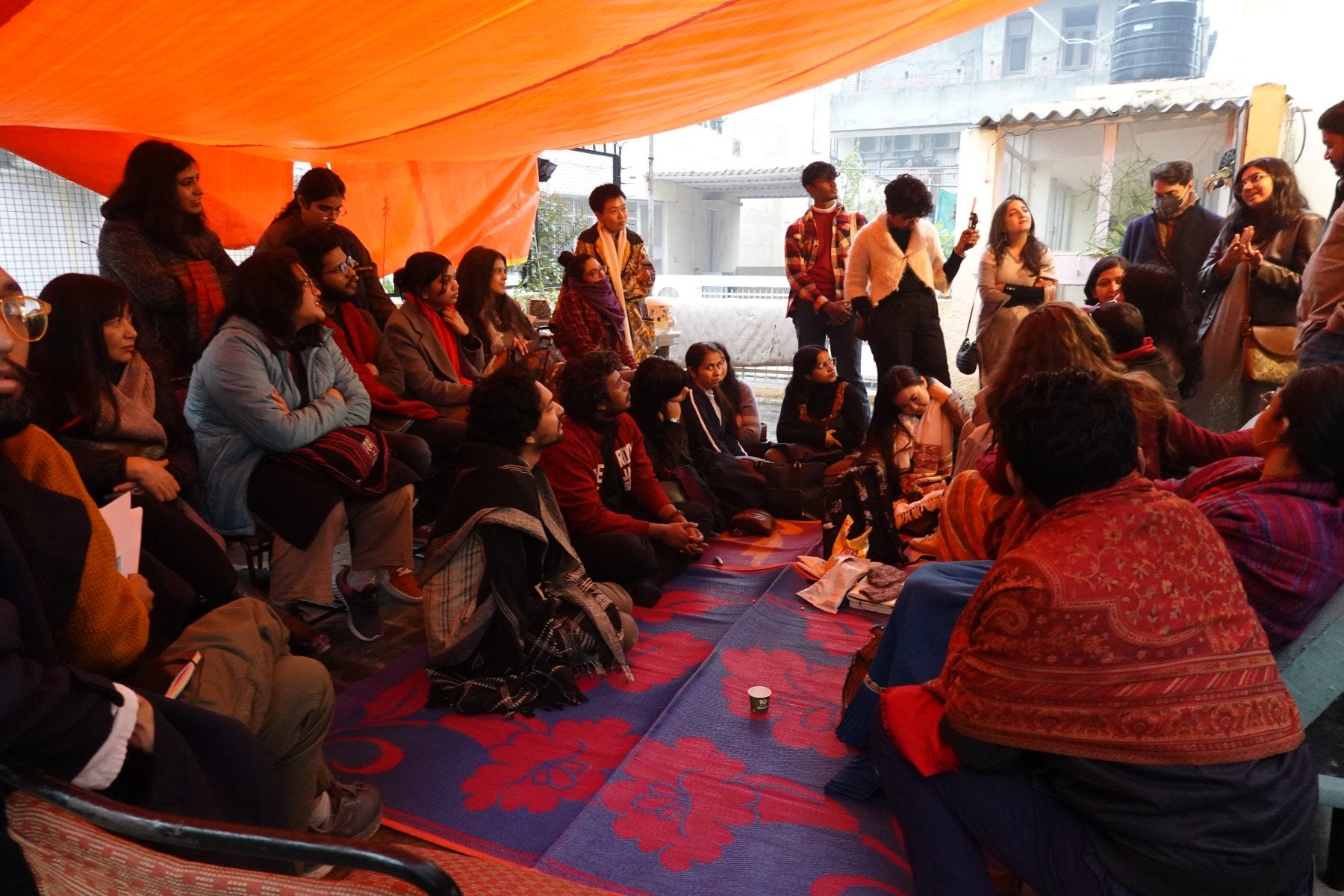
Kitchen Table Talks, Food Art Research Network, New Delhi.
MT: How did the Food Art Research Network begin, and what kinds of urgencies or desires shaped its formation?
MC: The network began in 2020, though the thinking behind it started earlier.
After a symposium and festival connected to food politics, many of us felt there was something important in continuing the conversation. We had spent time thinking about how our bodies hold stories and memories that aren’t always visible. Our metabolic lives depend on traditional knowledges, weather systems, labour practices, and ecological conditions in places we may never visit.
Then the pandemic happened. Suddenly food became impossible to ignore. Community kitchens emerged everywhere. Supermarket shelves emptied. Food supply chains became visible. It felt like a very urgent moment to gather around food.
So we began meeting online and asking what a research network connected to food might become.
MT: Food is often treated as nourishment or culture, but in your work it also becomes pedagogy—a way of studying together. How do you think about food as a form of study?
MC: I think that’s exactly what interests me. Kitchens have always been places of transmission and knowledge. They’re among the first places many of us learn. We learn through observation, repetition, experimentation, and failure.
I grew up around kitchens that were full of conversation. My grandmother taught me certain things, but I also lived in a collective house with Indian women and learned simply by being around people cooking, mixing spices, sharing stories, and experimenting.
What food does in creative practice is soften some of the anxieties people carry around study. With food, you can be learning a spice combination while talking about international trade. You can be discussing colonial histories of plants while cooking. Those things are somehow woven together.
When we gathered in Delhi with the School of Instituting Otherwise, food quickly opened onto conversations about class, caste, gender, migration, shame, memory, and desire. We thought food was the topic. Instead, it became the method through which all these other questions emerged.
Nothing else quite does that. Food is one of those things where whether you have it or whether you’re denied it, it shapes your relationship to the world. It shapes how you relate to one another, to systems, and to the environment.
MT: Many institutions collapse under the weight of bureaucracy or unsustainable structures. Do you see food—or the act of eating together—as a way of rethinking institutions from the ground up?
MC: I’ve spent a lot of time thinking about arts organisations that have kitchens and gardens.
What interests me is what happens when institutions become porous to different forms of knowledge. Kitchens allow lived experience, embodied knowledge, research, and intergenerational learning to coexist.
At the same time, I’m cautious. Sometimes institutions use food to bypass political questions they’re unwilling to address more directly.
What interests me more is the relationship between institutions and land. I’ve been researching how colonial forms of instituting emerged alongside transformations in land use. The plantation and the modern institution are deeply entangled.
Because of that, I’m not sure I would want to institutionalise the kitchen. The kitchen matters precisely because it exceeds some of those logics.
I remember visiting an arts institution outside Stockholm where the first thing you encountered was not a reception desk but a kitchen. It created a completely different kind of welcome. The institution felt oriented toward hospitality rather than administration.
MT: Food connects us to land, ecology, and histories of extraction and colonialism. How does the network grapple with these entanglements?
MC: There’s a huge range of people in the network, and lots of them are grappling with these questions through their own situated practices.
What I was thinking when we started the network, and what others were thinking too, was that none of these local ecologies are separate. Someone might be researching a particular landscape, a particular food system, or a particular plant in one place, but that ecology is always moving and shifting. It’s impacted by trade, migration, extraction, climate, and all sorts of metabolic movements across the world.
Follow the Plants emerged from that. It started as a very simple gesture. We wanted somebody researching a particular plant, commodity, or politics of land use in one part of the world to be placed in correspondence with somebody working on some entirely different elsewherw. Then we wanted to see what questions emerged.
What surprised me most was how difficult collective research actually is.
It’s really interesting how difficult it is to collectively research. It is difficult to unentangle yourself from your object and your interest and your thing and say, okay, I’m going to generously show up for another person’s research. And to also show an interest in what it means for the politics of another place to start impacting you.
Following plants also has a colonial history. Colonial plant hunters followed plants. Empires followed plants. So one of our questions became: how do we tell those histories while also unsettling them? How do we recognise that plants were never simply passive objects, but active participants in forms of world-making?
It’s an enquiry that never really ends.
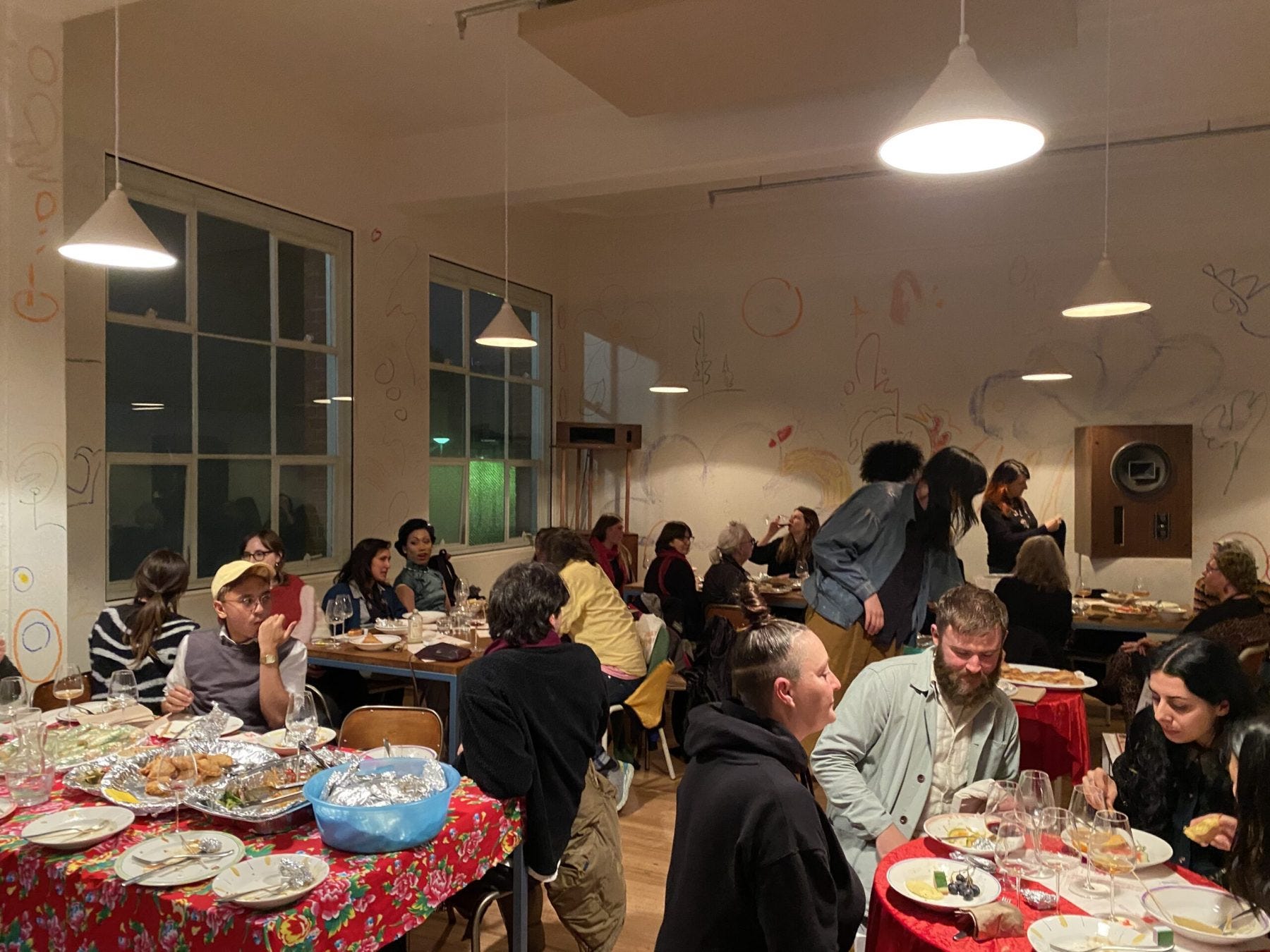
Disorganising Metabolisms, Food Art Research Network x School of Instituting Otherwise, Naarm Melbourne, 2021.
MT: Do you think about the Food Art Research Network as an archive of practices? Or as an ecology that continues to shift and grow?
MC: When we were designing the website with Mariana Martinez Balvanera from Cocina Co-Laboratorio, we spent a lot of time thinking about what the network actually was. Eventually we arrived at the idea that it was a network of living relations. Everybody involved is engaged in living relations within their own context while attempting to encounter the practices of others. It’s an unruly and ungovernable form of organising.
We have to hold it lightly. We can create conditions for encounter, but we can’t really direct where relationships go. The network archives projects and gathers knowledge, but it’s also about respecting the living relations that already exist in particular places. At the same time, it’s hard to maintain a network.
The Food Art Research Network appears and disappears in seasonal ways, but so do artistic practices. They come together and they fall apart.
Following this work over time has made me more generous towards that. It’s made me realise how difficult it is to sustain any form of creative practice over the long term.
MT: From my own experience working with you, I’ve seen how relationships and collective experiments sustain the work. What have been the most surprising or meaningful collaborations for you?
MC: So many. One of the collaborations I always return to is my work with Yvonne Billimore from BioArt Society.
Beyond the artistic work there is fundraising, partnership-building, editing, publishing, and organisational labour. What continues to surprise me is her generosity and willingness to stay with a process over many years.
Another important relationship has been with Maria Lind. I met Maria in Naarm, Melbourne. We had coffee for perhaps forty-five minutes. She asked me about the network and how it was being sustained. I told her that what the network really needed was institutional partnership.
Within a couple of weeks she wrote back and said she was thinking about doing a project on food and wondered whether we might do it together.
One of the things I value most is that she understands long durations. Some questions require ten years, not ten months. Food systems are certainly among those questions.
MT: What everyday practices—small, ongoing, maybe even fragile—keep the network alive?
MC: We attempted to create a steering group last year, though not a formal governance structure.
Partly that’s because institutionalising something built around friendship, research, and connection can end up privileging particular geographies.
We wanted to keep things looser. But what has sustained the network is a small organising group that has continued to keep things moving through care and generosity including Grace Gloria Denis and Joana Quiroga. Last year we organised a series called Untabled which you were part of with Alana Hunt. It involved people from across the network experimenting with different forms of gathering and exchange.
It was a huge amount of work for very little resource. And yet it was beautiful. There is a small group of people who check in with one another, support one another, and continue to ask what this network might become. That too is a form of everyday care.
MT: We are in a moment of collapse, where even food systems themselves are weaponised through blockade, war, or climate change. How do you see food as a site of survival and imagination in times like these?
MC: This question is probably the thing that keeps me awake. When so many Gazans have been martyred for the protection of seeds, for the protection of agricultural knowledge, for harvesting olive trees, and for maintaining forms of survival deeply connected to land and food, it becomes impossible not to think about food politically.
Food is often weaponised. I think it’s very easy to slip into platitudes around food. To say that food brings us together. That food connects us. That food is culture. All of those things are true. But food is also connected to histories of famine, dispossession, migration, and erasure.
My own family were historically displaced from Ireland. They would have experienced the famine. The reason my family left Ireland was likely complex but also connected to survival. When these displaced families arrive in the settler colony of Australia -they become part of a system that displaces indigenous traditions. Many global traumas are connected to food as a weapon of war and food as a mechanism of cultural erasure. A lot of those histories connect back to the establishment of the plantation.
So I think what we need is not simply to say that food connects us. We need to ask how we imagine our way out of the enclosures of the plantation system. Because those systems are in our bodies. They shape what we eat, how we eat, what we desire, how land is organised, how labour is organised, and how value is organised. I always have answers for how to do that.
But I think we need more opportunities to surface those violences. We need time to collectively acknowledge what those systems mean for our bodies, our health, our communities, and our collective wellbeing.
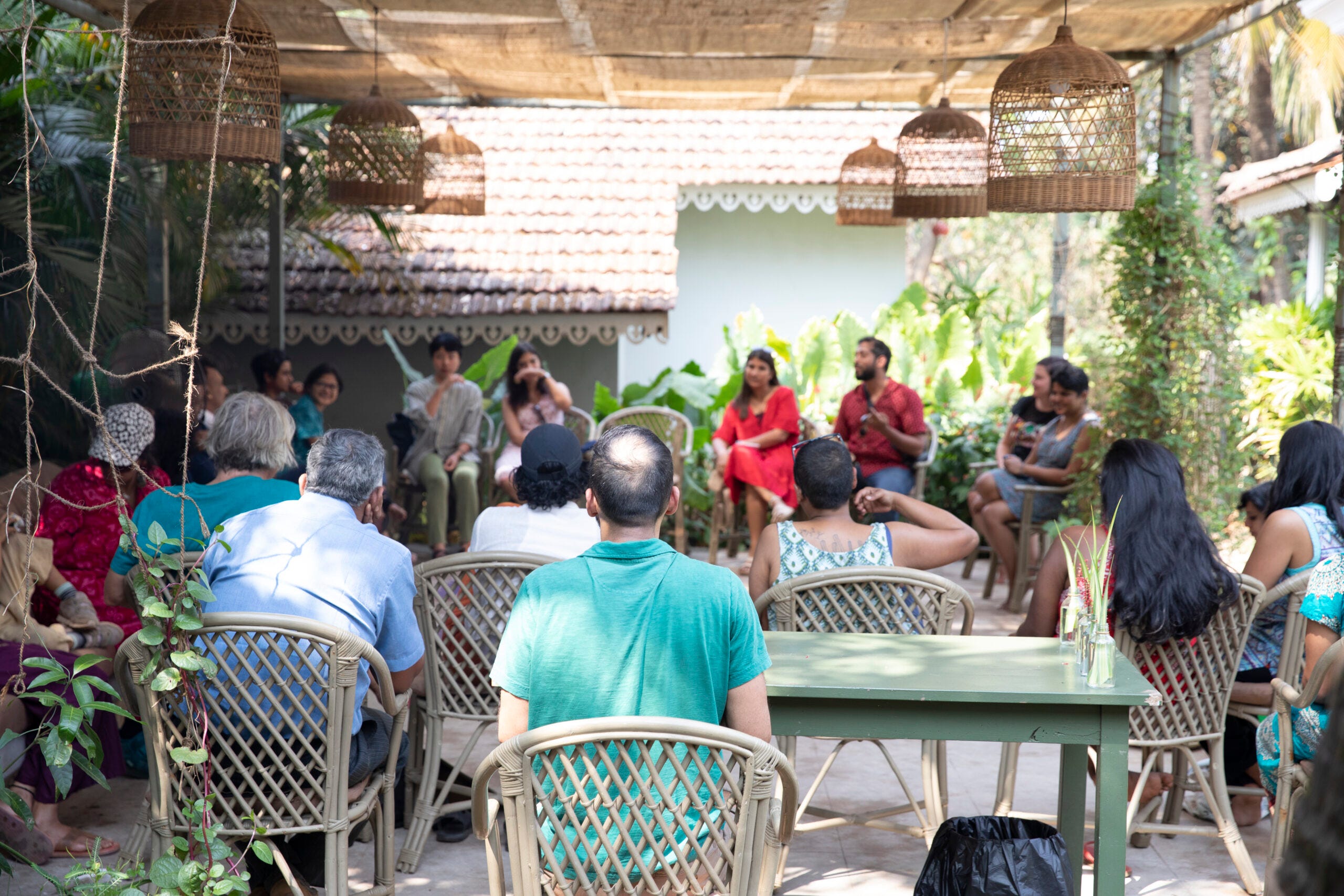
Edible Worlds, Edible Stories, Goa.
MT: Looking forward, what do you hope the Food Art Research Network makes possible in the next decade?
MC: One of the things I’m excited about is launching Follow the Plants.
And one of the things that’s been really meaningful about the invitation from Maria Lind and Kin Museum in Kiruna is that it isn’t framed as a short-term project. It’s framed as a long-term enquiry.
It might continue for ten years. There doesn’t need to be an end point. I really like that way of thinking because these questions don’t have endings. Food systems and ecological questions don’t have endings. They’re ongoing. I hope that one day we might have the resources to support longer forms of research. I’d love for the network to profile more of the artists and practitioners involved. I’d love to find ways of sharing the work that’s happening across different places without creating huge administrative structures around it.
Because I think the next decade is only going to bring further resource depletion, ecological degradation, and instability. And I think that when we come together to think about food and ecosystems, something else happens. We create different patterns in our brains for survival and relating to one another including ways of understanding our dependence on each other and on the worlds that sustain us.
In that sense, I think what we’re doing is more than research.
We’re rehearsing another world together.